

Description
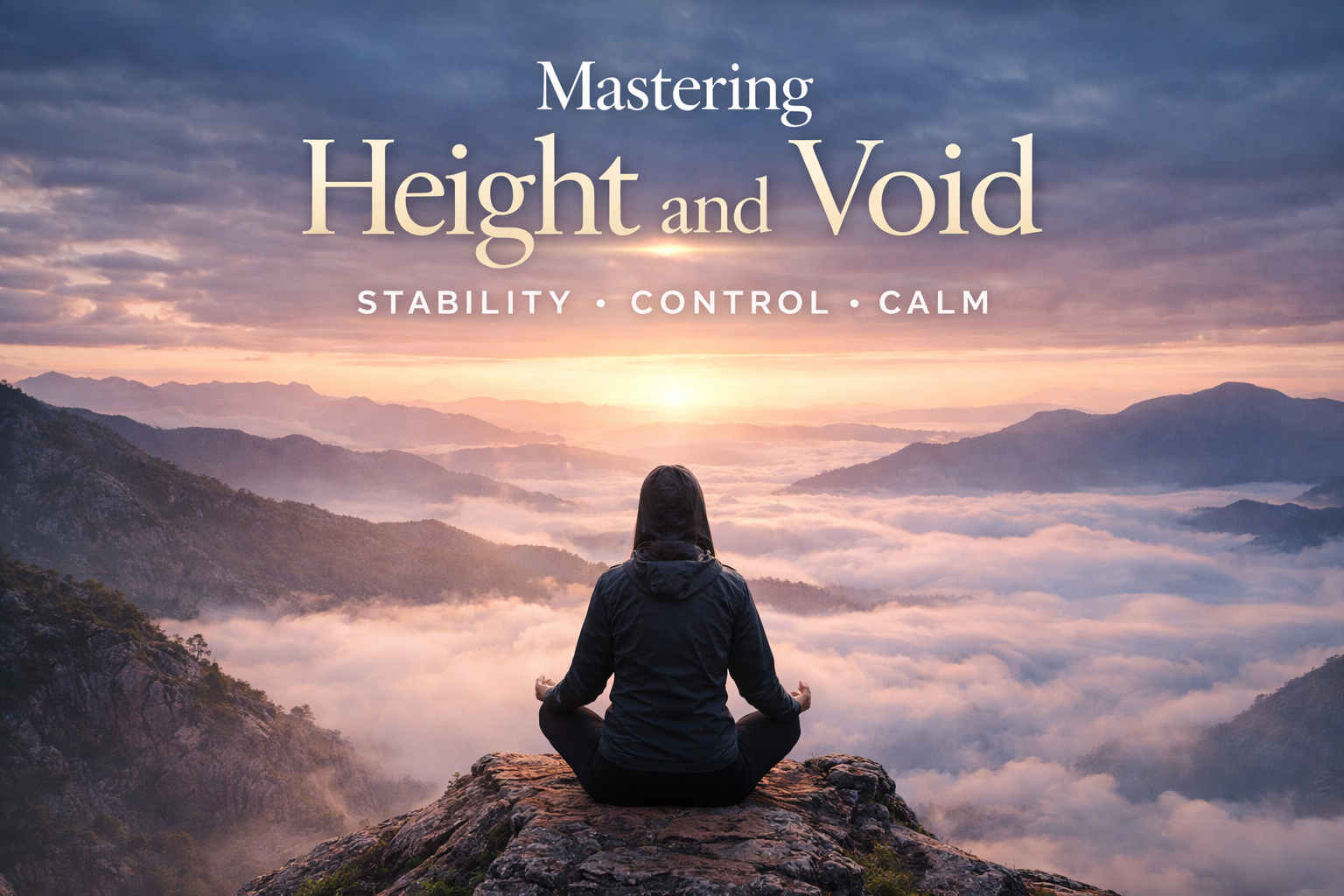
Stability, Control and Calm – Mastering Height and Void
Mastering Height and Void is a structured experience designed to support vestibular balance, spatial orientation and internal stability when facing height and depth.
This video is designed to recalibrate your internal response to height and spatial depth.
The body does not distinguish between memory and present experience.
When a shock has been registered, the nervous system may continue to react automatically, even when there is no real danger.
This work supports a new response.
Through structured energetic transmission and nervous system regulation, the perception of height is reorganised from alarm to stability, from contraction to control.
This experience includes:
-
Holy Fire as stabilizing field
-
Karuna Reiki for shock release and identity restructuring
-
Imara for deep-rooted patterns
-
Violet Flame Reiki with equilibrium focus for spatial balance and inner centering
-
Nervous system recalibration with attention to vestibular balance
The vestibular system plays a central role in how we perceive height, orientation and stability.
By supporting this internal balance system, the body learns that height does not equal danger.
The vestibular system, located in the inner ear, regulates balance, spatial orientation and the perception of verticality.
It continuously informs the brain about:
-
Position in space
-
Direction of movement
-
Relationship between the body and gravity
When looking from a height, the eyes send depth information.
The vestibular system interprets that information and determines whether the body is stable.
If a strong imprint has been stored in the past, the visual signal can trigger an amplified vestibular response.
The result may be vertigo, instability, muscular tension or sudden internal contraction.
This experience supports a recalibration of that mechanism.
The visual system and the vestibular system begin to cooperate again instead of reacting defensively.
The body recognizes spatial depth while maintaining internal alignment.
Height is processed as orientation.
The inner axis remains steady.
Balance becomes automatic.
The nervous system integrates a new spatial reference: stability within expansion.
Included Identity-Based Affirmations
This video also provides structured affirmations designed to reinforce neurological stability and spatial confidence.
They can be repeated:
-
During the video
-
After the session
-
Whenever height or depth triggers a response
Logical Recall
“The body does not distinguish between memory and the present.”
New Understanding
“My nervous system has now received a different signal.”
Identity
“I can look from above and remain stable.”
Seal
“Height is space. The void is perspective.”
Additional identity affirmations included:
“My body has learned a new response.”
“I can look from above and remain stable.”
“I am centered.”
“Height does not destabilize me, it expands me.”
“The void is not danger. It is space.”
“My system is in balance.”
Or in its most essential form:
“I look from above and remain stable.
I am balance within space.”
FAQ
1. Who is this video for?
This experience is designed for individuals who feel instability, tension or loss of control when exposed to height, depth or elevated spaces.
2. Does this video replace professional therapy?
This work supports nervous system regulation and spatial recalibration. It complements personal development and well-being practices.
3. What happens during the session?
The video guides the nervous system into a state of stability while gradually reorganising the internal response to height and depth.
4. What is the role of the vestibular system in fear of heights?
The vestibular system regulates balance and spatial orientation. When recalibrated, it allows the body to perceive height while remaining internally steady.
5. How long should I use the video?
It can be used repeatedly. Consistency strengthens the new neurological pattern.
6. Can I repeat the affirmations outside the video?
Yes. The affirmations are designed for integration and can be repeated anytime to reinforce stability and spatial confidence.
7. What physical sensations may occur?
Some people experience relaxation, grounding, deeper breathing, or a sense of internal alignment as the system stabilises.
8. Is this suitable for mild vertigo related to height perception?
This video supports spatial orientation and internal balance. For medical conditions, consult a healthcare professional.
9. How quickly can results be felt?
Some individuals notice shifts immediately. For others, the change consolidates progressively with repetition.
10. What is the goal of this experience?
Expansion without instability.
Perspective without contraction.
Control within space.
11. Can this help if the reaction started after a specific event?
Yes. The work supports reprocessing of stored spatial imprints and integrates a new internal reference of safety.
12. What makes this video different?
It addresses spatial perception, vestibular balance, nervous system regulation and identity reinforcement together in a structured way.
13. Can this video help even if I avoid heights completely?
Yes. The work supports internal recalibration even without direct exposure.
14. Should I watch it while standing at a height?
For initial sessions, a calm and neutral environment is recommended. Integration can later extend to real situations.
15. How does repetition improve results?
Repetition reinforces the new neurological reference and strengthens balance perception over time.
16. Can this support confidence in everyday situations such as balconies or bridges?
Yes. The goal is stable orientation in any elevated environment.
17. What is meant by spatial confidence?
Spatial confidence is the ability to perceive height or depth while maintaining internal alignment and control.
18. Does this work with sudden vertigo triggered by visual depth?
It supports visual-vestibular coordination and internal balance regulation.
19. Can I combine this with breathing practices?
Yes. Slow breathing enhances nervous system regulation during the session.
20. Is this suitable for people who experience tension when watching height scenes on television?
Yes. The work addresses the internal response to perceived depth, even through visual media.
21. How is identity involved in overcoming height instability?
When identity shifts from “unstable in height” to “stable within space,” the nervous system aligns with that new reference.
22. What long-term change does this support?
A stable internal axis, automatic balance regulation, and calm perception of height.





 I am an animal lover and give animals Reiki sessions for free. If you are interested just send me an email and I will be more than happy to give a free Reiki session to your pets.
Reviews
There are no reviews yet.